

Blog
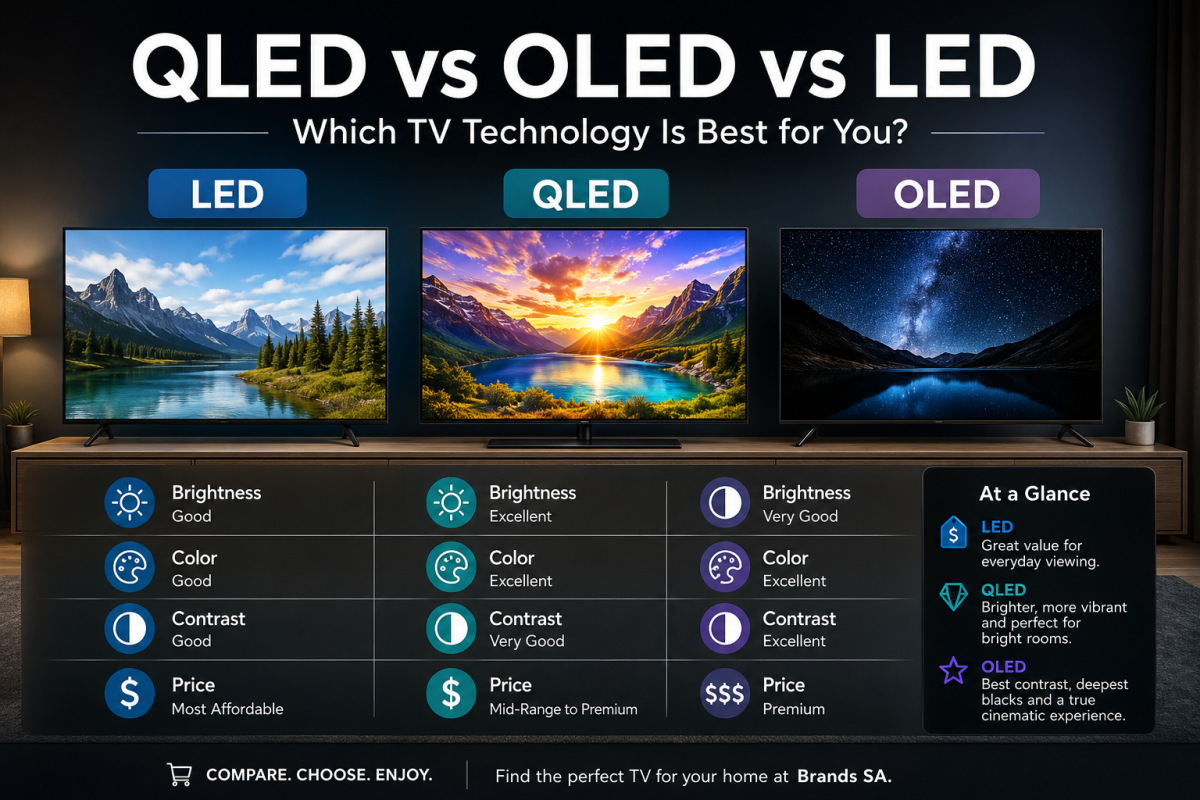
QLED vs OLED vs LED: Which TV Technology Is Best for You?
Buying a new TV can feel surprisingly complicated. You’ll see terms like LED, QLED, OLED, Mini-LED and Neo QLED everywhere, but what do they actually mean — and which one is right for your home?
The good news is that choosing between QLED vs OLED vs LED becomes much easier once you understand how each technology produces an image.
Whether you’re upgrading your lounge TV, building a home cinema or simply looking for the best picture quality for your money, this guide from Brands SA breaks down the differences so you can make a confident choice.
LED vs QLED vs OLED: The Quick Answer
If you want the short version:
- LED: A good affordable option for everyday TV viewing.
- QLED: A brighter, more colourful upgrade over standard LED, particularly good for bright rooms and HDR content.
- OLED: The premium choice for deep blacks, outstanding contrast and a cinematic viewing experience.
There isn’t one technology that is automatically best for everyone. Your room, viewing habits and budget all matter.
What Is an LED TV?
LED TVs are essentially LCD televisions that use LED lights as a backlight. The LEDs illuminate the LCD panel so you can see the picture.
Standard LED TVs remain popular because they offer a combination of affordability, brightness and good overall picture quality. They are available in a wide range of screen sizes and price points, making them particularly attractive for families and shoppers looking for a practical everyday television.
However, standard LED TVs generally don’t offer the same colour performance, contrast or black levels as more advanced display technologies.
That doesn’t mean an LED TV is a bad choice. If you’re mainly watching regular television, streaming shows, sports or YouTube and want to keep your budget under control, a good LED TV can still deliver an excellent viewing experience.
What Is a QLED TV?
QLED stands for Quantum Dot Light Emitting Diode.
Despite the name, QLED televisions still use an LED backlight. The major difference is that they add a layer of quantum dots to improve the way light and colour are produced. This can result in brighter images, richer colours and a wider colour range than many standard LED TVs.
QLED has become a popular middle ground between standard LED and premium OLED.
One of the biggest advantages of QLED is brightness. This makes QLED TVs particularly useful in rooms with lots of natural light, where a darker display can sometimes be harder to see.
QLED can also be an excellent choice for sports, gaming and HDR movies because of its ability to produce bright, vibrant images.
QLED advantages
- Excellent brightness
- Vibrant, rich colours
- Great for bright rooms
- Excellent HDR performance on higher-end models
- Available in a wide range of sizes and prices
- No OLED-style permanent burn-in concern
It’s important to remember that not all QLED TVs perform the same. Features such as local dimming, panel quality, processing and refresh rate can make a significant difference between models.
What Is an OLED TV?
OLED stands for Organic Light Emitting Diode.
Unlike LED and QLED televisions, OLED panels don’t require a separate backlight. Each pixel can produce its own light and can be switched off completely when displaying black.
This gives OLED its biggest advantage: exceptionally deep blacks and outstanding contrast.
Imagine watching a scene in space. On an OLED TV, the pixels representing the blackness of space can essentially turn off, while stars remain bright. This produces a highly cinematic image with excellent contrast.
OLED TVs are particularly impressive when watching movies and series in darker rooms, and they also offer very fast pixel response times, making them attractive to gamers.
OLED advantages
- Exceptional black levels
- Outstanding contrast
- Excellent picture quality
- Fast response times
- Excellent viewing angles
- Very cinematic image quality
- Extremely thin designs are possible
The main considerations are price, brightness compared with some high-end QLED/Mini-LED models, and the possibility of image retention or burn-in with certain long-term usage patterns. Modern OLED TVs have technologies designed to reduce this risk, but it is still something buyers should understand.
QLED vs OLED vs LED: What Is the Difference?
The easiest way to understand the three technologies is to look at how they handle the things that matter most when watching TV.
1. Picture Quality
OLED wins overall for contrast and black levels.
Because each OLED pixel can turn itself off, OLED can produce incredibly deep blacks and very high contrast.
QLED TVs can still produce excellent picture quality, especially higher-end models with advanced local dimming. Standard LED TVs generally sit below QLED and OLED in overall picture performance.
Winner: OLED
2. Brightness
QLED generally has the advantage when it comes to brightness.
This is particularly important if your TV is positioned opposite a window or in a room with lots of sunlight.
High-end QLED and Mini-LED televisions can produce extremely bright images, making HDR content and sports particularly impressive. OLED TVs have also become significantly brighter over the years, so the gap isn’t as simple as it once was.
Winner: QLED
3. Black Levels and Contrast
This is where OLED really stands out.
An LED or QLED television relies on a backlight, meaning some light can remain behind areas that are supposed to appear black. Advanced local dimming can dramatically improve this, but OLED can switch individual pixels off completely.
Winner: OLED
4. Colour
Both modern QLED and OLED televisions can produce outstanding colours.
QLED’s quantum-dot technology is specifically designed to improve colour reproduction and brightness, while OLED delivers excellent colour alongside its exceptional contrast. The exact result depends heavily on the individual TV model.
Winner: QLED and OLED
5. Viewing Angles
OLED generally performs better when people are watching the TV from different positions around the room.
This makes it particularly useful for large family rooms where everyone isn’t sitting directly in front of the screen.
Winner: OLED
6. Gaming
OLED can be an excellent choice for gamers thanks to extremely fast response times, excellent contrast and smooth motion.
However, modern QLED and Mini-LED TVs can also be excellent gaming televisions, particularly if you want very high brightness and features such as high refresh rates, VRR and HDMI 2.1.
Winner: Depends on the model and your priorities
7. Price
Standard LED TVs are generally the most affordable option.
QLED sits across a broad price range, from relatively affordable models to premium televisions with sophisticated Mini-LED backlighting.
OLED generally sits further towards the premium end of the market.
Winner: LED for affordability
QLED vs OLED vs LED Comparison
| Feature | LED | QLED | OLED |
|---|---|---|---|
| Picture quality | Good | Excellent | Outstanding |
| Black levels | Good | Very good | Excellent |
| Contrast | Good | Very good | Excellent |
| Brightness | Good | Excellent | Very good to excellent |
| Colour | Good | Excellent | Excellent |
| Viewing angles | Fair to good | Good | Excellent |
| Gaming | Good | Excellent | Excellent |
| Bright rooms | Good | Excellent | Good to very good |
| Dark rooms | Good | Excellent | Excellent |
| Price | € Most affordable | €€ Mid-range to premium | €€€ Premium |
Which TV Is Best for a Bright Room?
If your lounge has large windows, plenty of sunlight or bright overhead lighting, QLED is worth serious consideration.
Its strong brightness can help the picture remain vibrant and easy to see even when the room isn’t dark.
High-end QLED and Mini-LED televisions can be particularly impressive in bright environments.
Which TV Is Best for Movies?
For movie lovers, OLED is difficult to beat.
Its ability to produce extremely deep blacks creates the kind of contrast that makes dark cinematic scenes look more realistic.
If you regularly watch Netflix, Disney+, Showmax, Blu-ray movies or other cinematic content in the evening with the lights down, OLED can provide an exceptional home-theatre experience.
Which TV Is Best for Sports?
For sports, both QLED and OLED can be excellent choices.
QLED’s brightness is particularly useful for daytime viewing, while OLED’s fast response can help with fast-moving action.
When shopping for a sports TV, don’t only look at QLED or OLED. Also check the refresh rate, motion processing, viewing angle and screen size.
Which TV Is Best for Gaming?
Gamers should look beyond the display technology itself.
A great gaming TV should ideally offer:
- A high refresh rate
- Low input lag
- HDMI 2.1
- Variable Refresh Rate (VRR)
- Auto Low Latency Mode (ALLM)
- Good HDR performance
OLED is particularly attractive for its fast response time, while premium QLED and Mini-LED models can deliver impressive brightness and gaming features.
So, Should You Buy LED, QLED or OLED?
The best choice depends on what matters most to you.
Choose LED if:
You want an affordable TV for everyday viewing and don’t need premium picture technology.
Choose QLED if:
You want bright, vibrant images, watch lots of sport, have a bright room or want an excellent balance between performance and price.
Choose OLED if:
Picture quality is your top priority and you want exceptional blacks, contrast and cinematic performance.
The Brands SA Verdict
There is no single “best TV” for every household.
For shoppers on a tighter budget, LED remains a sensible choice. If you want to step up the picture quality without necessarily going all the way to a premium OLED, QLED offers an excellent balance of brightness, colour and value.
And if you’re looking for a premium cinematic experience with outstanding contrast and deep blacks, OLED is the technology to consider.
Most importantly, don’t choose a TV based on the acronym alone. Screen size, resolution, refresh rate, HDR support, processing, brightness and the quality of the individual model can all have a major impact on your viewing experience.
At Brands SA, you can compare TVs across different technologies and price points to find the right screen for your home.
Looking for your next TV? Browse the latest TVs at Brands SA and find the right display for your budget and viewing style.